Kirby Drive Is Under Construction for Two Completely Different Reasons
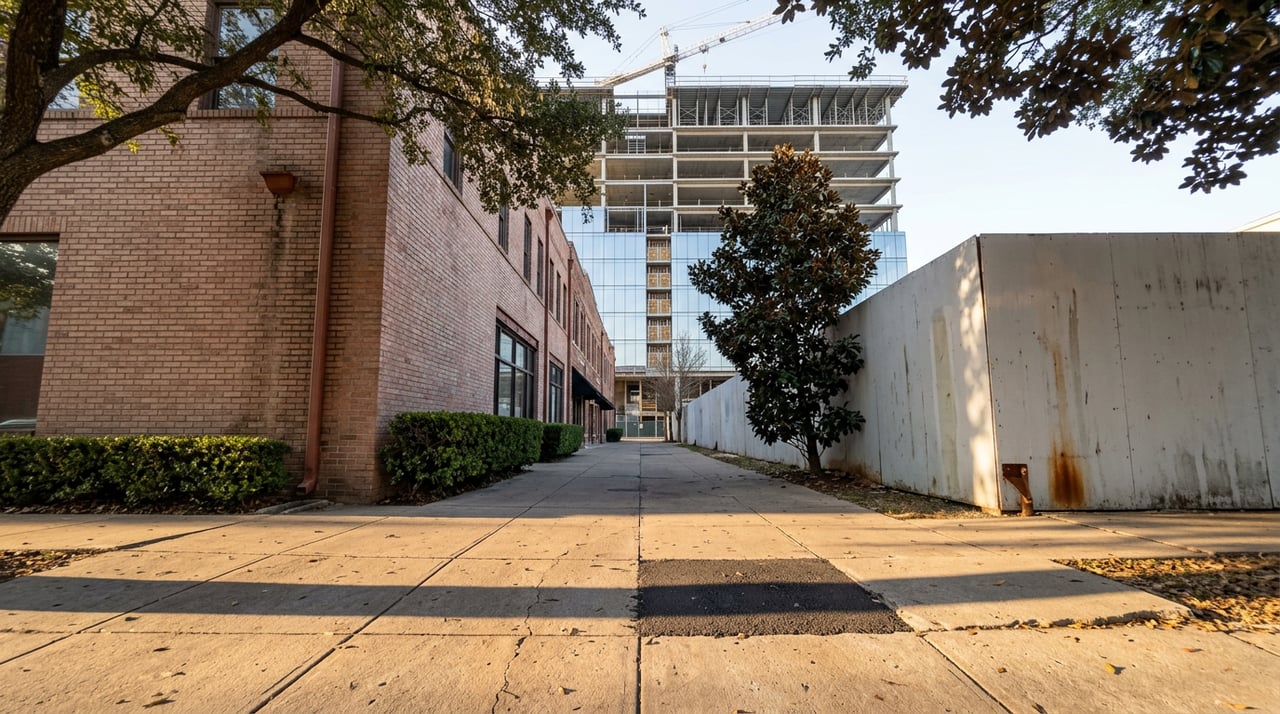
Ask anyone who drives Kirby Drive between Westheimer and Bissonnet what all the orange barrels are for, and you'll get two answers depending on which block they mean. On one stretch, crews are ripping up seventy-year-old water and sewer lines that have never been touched. A few blocks over, cranes are stacking steel for a thirty-eight-story apartment tower. Both count as construction. Only one of them is fixing something broken.
That distinction matters if you live here, because it explains why the disruption on your commute isn't going away soon, and why the storefronts around it keep changing faster than the road itself.
In February 2026, Houston City Council approved a $125 million capital improvement budget for the Upper Kirby Tax Increment Reinvestment Zone, covering fiscal years 2026 through 2030. The bulk of that money, $82.5 million, goes to reconstructing roadways the district has been patching for decades. Another $2.2 million is earmarked for drainage.
Of that total, $18.6 million is dedicated to Kirby Drive itself, running from US-59 to Bissonnet Street. The scope isn't cosmetic repaving. It covers roadway reconstruction, storm sewer, water, wastewater, and burying the private utility lines that still run overhead on parts of the corridor.
This isn't the district's first attempt at this. Back in 2014, the Upper Kirby Management District ran a similar utility relocation project along Bissonnet between Wakeforest and Kirby, part of a broader effort to upgrade storm drainage capacity that started along Kirby near NRG Stadium and worked its way north toward Westheimer. District officials said at the time that the neighborhood's major thoroughfares dated to the 1950s and had never been fully rebuilt, only patched. What's happening on Kirby Drive right now is the next phase of that same decade-plus project, finally reaching the street residents actually use to get anywhere.
$18.6 million of the district's current budget is going specifically into the stretch of Kirby Drive between US-59 and Bissonnet, the same corridor where two of the largest private developments in Upper Kirby's history just broke ground.
That timing isn't a coincidence worth ignoring. In April 2026, Southern Land Company broke ground on a $270 million project at the corner of Kirby Drive and Kipling Street, near the Whole Foods most residents already shop at. The development includes two towers on a shared parking podium: Lily River Oaks, a 38-story apartment building with 331 units including 18 penthouses, and 2811 Kirby, a 10-story office building with roughly 107,000 square feet of Class AA space that Stream Realty Partners is leasing. Between the two towers, the project is adding roughly 15,000 square feet of restaurant space, split between ground-floor storefronts in the shared podium and a standalone restaurant building behind the towers. Amenities include a rooftop pool deck on the 38th floor and a garden deck spanning both buildings on the seventh. The developer expects the project to create close to 500 jobs across construction, hospitality, and office work, and estimates about three years to complete.
A few blocks away, Transwestern is building something different on a 17-acre site along Buffalo Speedway that used to be an Exxon research facility. The project, called The RO, sits between River Oaks and Upper Kirby and is designed by Michael Hsu Office of Architecture as a European-style retail village: cobblestone walkways, oak-shaded patios, roughly 80,000 square feet of retail split about evenly between shops and restaurants. Parking is entirely underground, which means the retail level is meant to be walked, not driven through. Two residential towers anchor it, including a 28-story, 317-unit building called the Clayton.
Neither of these projects needed the city's road money to get built. But a 38-story tower and a 17-acre pedestrian district both pull hard on water, sewer, and drainage capacity that a 1950s-era pipe network wasn't sized for. The infrastructure work on Kirby Drive isn't cosmetic timing next to that kind of density. It's the corridor catching up to what's already been approved.
None of that construction has slowed down what's opening at street level. Grant Pinkerton, the Houston pitmaster behind Pinkerton's Barbecue in the Heights, opened his third location in Upper Kirby on January 20, 2026. The building itself is part of the draw: it's the 1940s structure that once housed Phil's Restaurant and later Lionel's Flame Room, a longtime Houston piano bar, before becoming the 59 Diner. Pinkerton restored the exterior neon as part of the renovation, a deliberate nod to the building's own history rather than a generic build-out. Pinkerton has been a finalist in the chicken and ribs categories at the Houston Livestock Show and Rodeo's BBQ World Championship, and was the first pitmaster named to Forbes' 30 Under 30 list back in 2018.
Closer to Richmond Avenue, restaurateur Sterling Lewis opened his first concept, Confessions, in April 2025. The menu leans Southern, with dishes like strawberry cornbread, spicy peach wings, and honey truffle fried chicken, but the format shifts as the night goes on: traditional dining until around 9 or 10 p.m., when the room turns into a DJ-curated space. Lewis has said the restaurant drew high-profile visitors in its first year, including Shaquille O'Neal, 50 Cent, and GloRilla, which is unusual traction for a restaurateur's first venture in this part of town.
Retail along the corridor has been just as active. Lark & Berry, a British jewelry brand known for lab-grown diamonds, opened its first U.S. location on Richmond Avenue in December 2024, inside a renovated 1950s midcentury bungalow the brand redesigned to echo London's Mayfair district. It's a small detail, but it's the kind of adaptive reuse that's becoming more common in Upper Kirby as older residential-scaled buildings get repurposed rather than torn down, the same instinct behind Pinkerton's choice of building.
Huynh Restaurant, a longtime downtown fixture, announced plans in 2025 to relocate to Upper Kirby off Richmond Avenue, taking over the former Sonoma Wine & Cheese space. As of that announcement, the restaurant was targeting a window of late 2025 into early 2026 for the move, though no firm closing date for the downtown location had been set at the time.
Meanwhile, at the intersection of Kirby Drive and Westheimer Road, Shops at Arrive River Oaks added three new tenants in a lease announcement from Transwestern Real Estate Services: Cullen Jewelry, an Australia-based brand opening its first U.S. showroom in a 2,716-square-foot space; Kale Functional Medicine, a wellness clinic relocating from Westcott Street; and Bussia, a new restaurant from the owners of Pane e Vino in Katy. Combined, the three leases account for close to 9,600 square feet, a modest but telling sign that the corridor's retail turnover isn't slowing down even with the road work underway.
The TIRZ budget runs through fiscal year 2030, which means the construction on Kirby Drive itself isn't a short-term inconvenience. It's a multi-year project, following the same pattern the district used on Bissonnet a decade ago: work in sections, expect detours to shift as segments finish, and expect the disruption to move rather than disappear all at once. If you want to track it block by block rather than guess from the barrels, the Upper Kirby District posts updates and holds regular public meetings on the TIRZ's progress.
What won't wait for the road to finish is everything else. Southern Land's towers are still roughly three years from completion, The RO is still taking shape a few blocks away, and if the last two years are any indication, more restaurant and retail announcements will land before either project tops out. The corridor's texture, who's cooking, who's leasing, what's moving in next, is going to keep shifting well past the point when the cones finally come down.
For residents, that's less a disruption to endure than a neighborhood mid-build, with the visible mess on the street and the visible progress at the corner both part of the same story.
If you're weighing what any of this means for a property here, whether you're watching values shift alongside the construction or just curious what a home near the corridor is actually worth right now, the team at Beth Wolff Realtors has spent decades tracking exactly this kind of neighborhood-level change across Houston's inner loop. Request a Personalized Consultation whenever you're ready to talk specifics.
Stay up to date on the latest real estate trends.
September 24, 2026
September 17, 2026

September 10, 2026
September 3, 2026
August 27, 2026
August 20, 2026
August 13, 2026
August 6, 2026
August 6, 2026